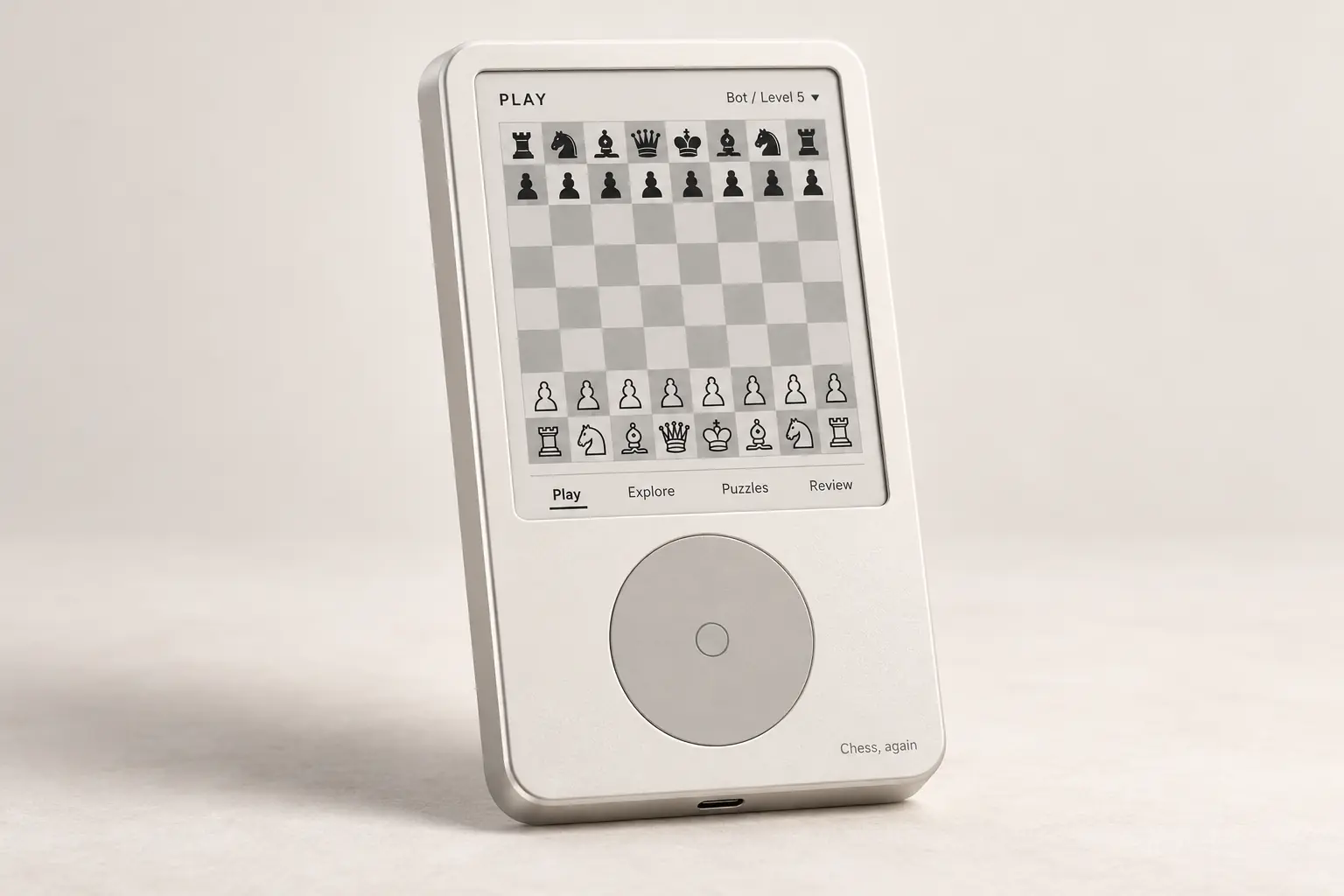
White
Warm, matte and understated. A finish direction for a device that feels at home beside your favourite chair.
A handheld chess concept
A little more chess.
A little less phone.
A quiet screen. Physical controls.
Room for your next move.
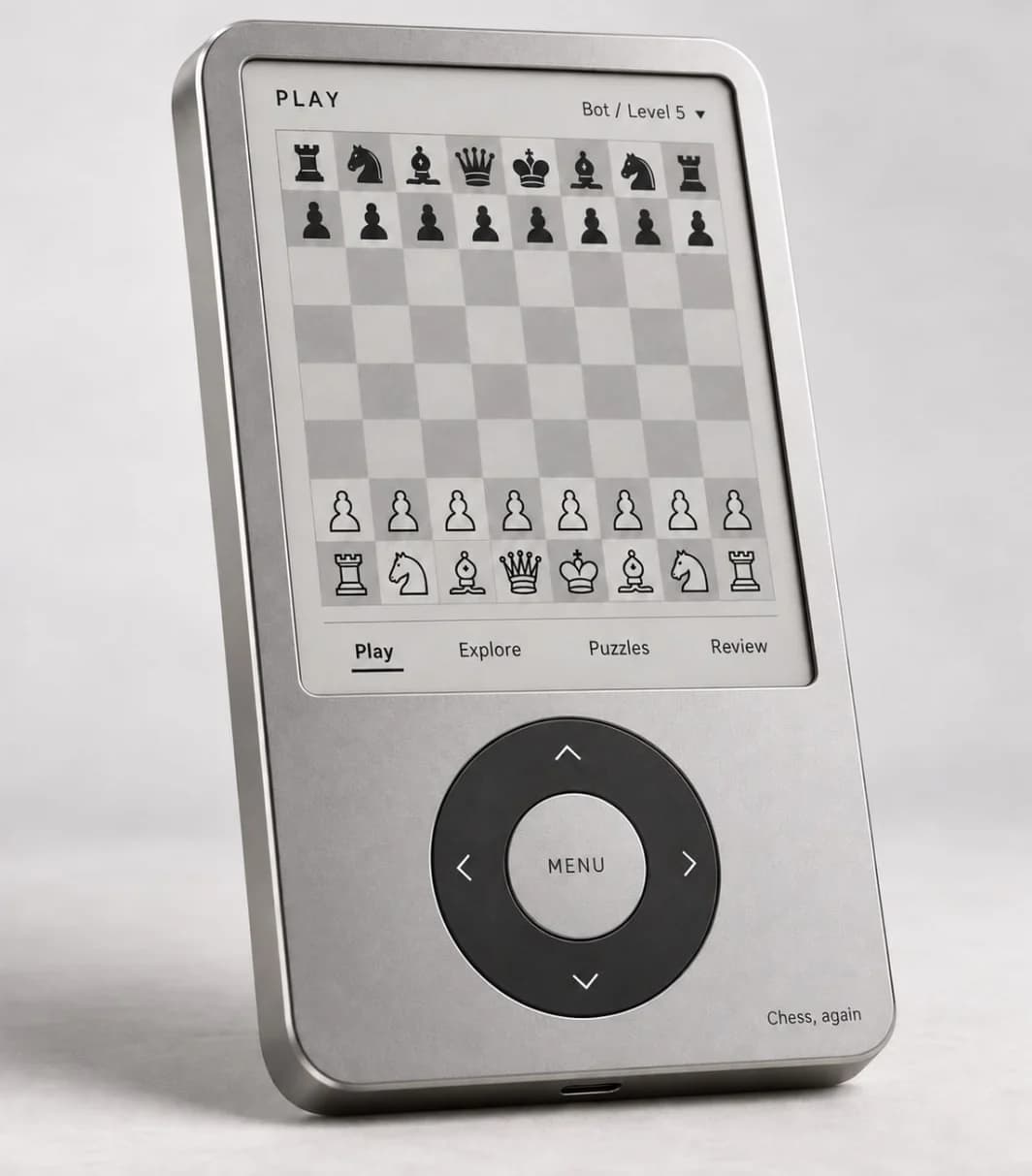
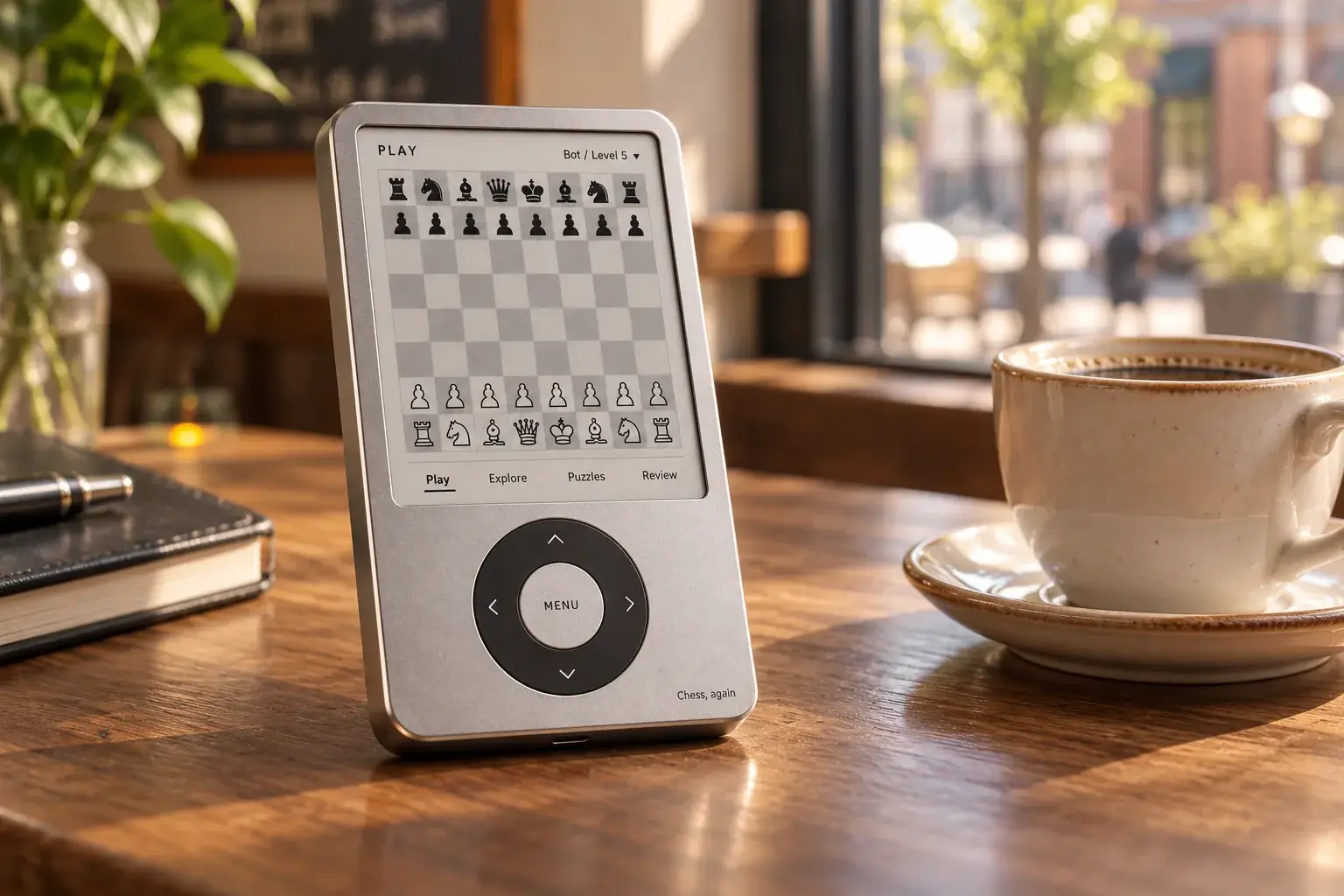 Concept render
Chess asks for a little attention. We think it deserves a little space of its own.
We’re exploring a device that feels like an invitation to play: a simple board, controls you can feel, and a game that goes with you.
Help shape what comes nextA dedicated device, built around one game.
A circular control and a simple monochrome board.
A concept for your coffee break, commute and quiet evening.
A browser interaction study
Explore the modes we are planning, then try the idea of moving by touch or physical control. This preview illustrates the direction; it is not connected to a chess service or finished hardware.
Planned Chess.com and Lichess support would bring familiar opponents and friends to a dedicated place to play.
Use the arrows to move the highlight and Select to choose a square. Select e2, move up twice and select e4 to try the sample move.
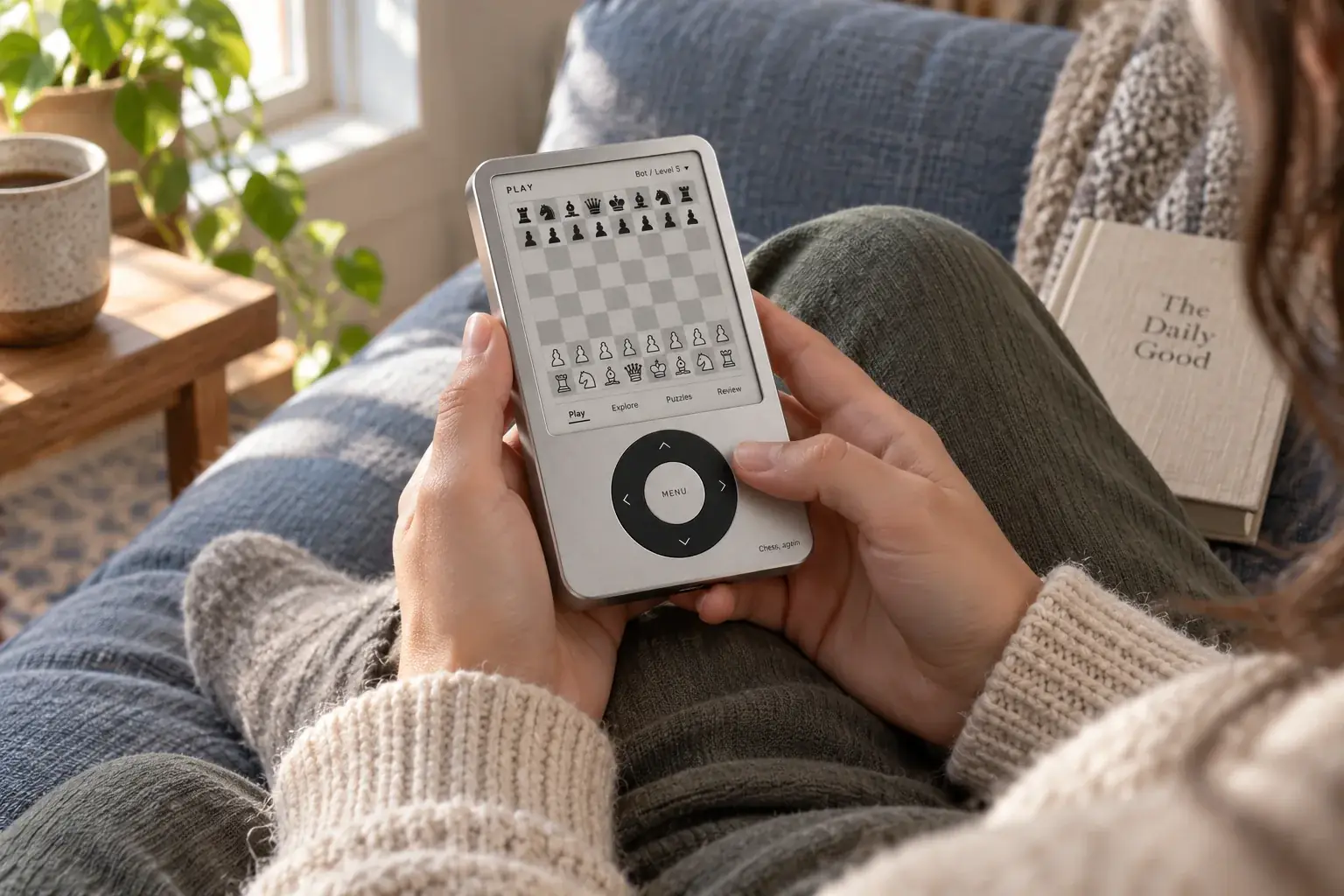
Connected play · planned
Your chess life already has a home. We are working toward Chess.com and Lichess support, so you can keep familiar opponents and communities while giving the game a dedicated space in your hands.
Play a friend from your favourite chair. Find a new opponent over coffee. Let the game be the reason you pick up the device.
Integrations are in development. Availability, account requirements and supported game types will be confirmed before orders. No official partnership is implied.
Explore connected playThe idea is simple
The world can wait
for one more move.
A dedicated place for the game. A little space for your attention.
Why give chess its own device?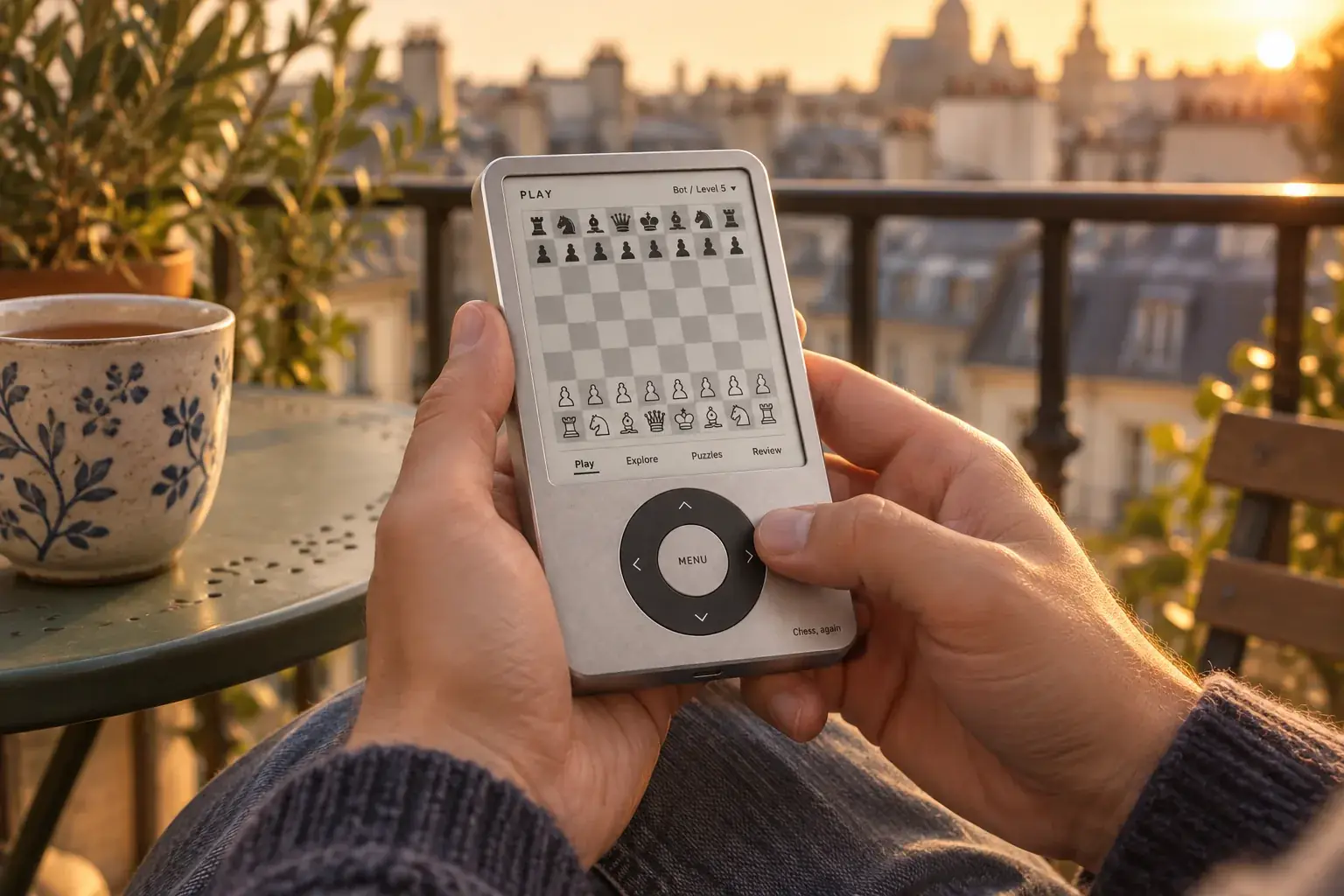
Interaction design · in development
The circular control is at the heart of our design: a clear way to navigate, choose and confirm. It gives the handheld a character of its own, with a rhythm that belongs to the game.
We are working on touch, too. The aim is to make selecting a piece or a square feel natural, while keeping the board calm and readable. Both approaches need testing on hardware before we settle the final specification.
Finish studies · concept renders
Two looks for the same idea. Warm white gives the handheld a soft, familiar presence. Dark titanium explores a deeper tone, with a satin texture and a subtle edge that catches the light.
Both studies show the circular touch disc below the board. Colours and materials are still being evaluated; “dark titanium” names this colour direction rather than a confirmed titanium enclosure.
Warm, matte and understated. A finish direction for a device that feels at home beside your favourite chair.
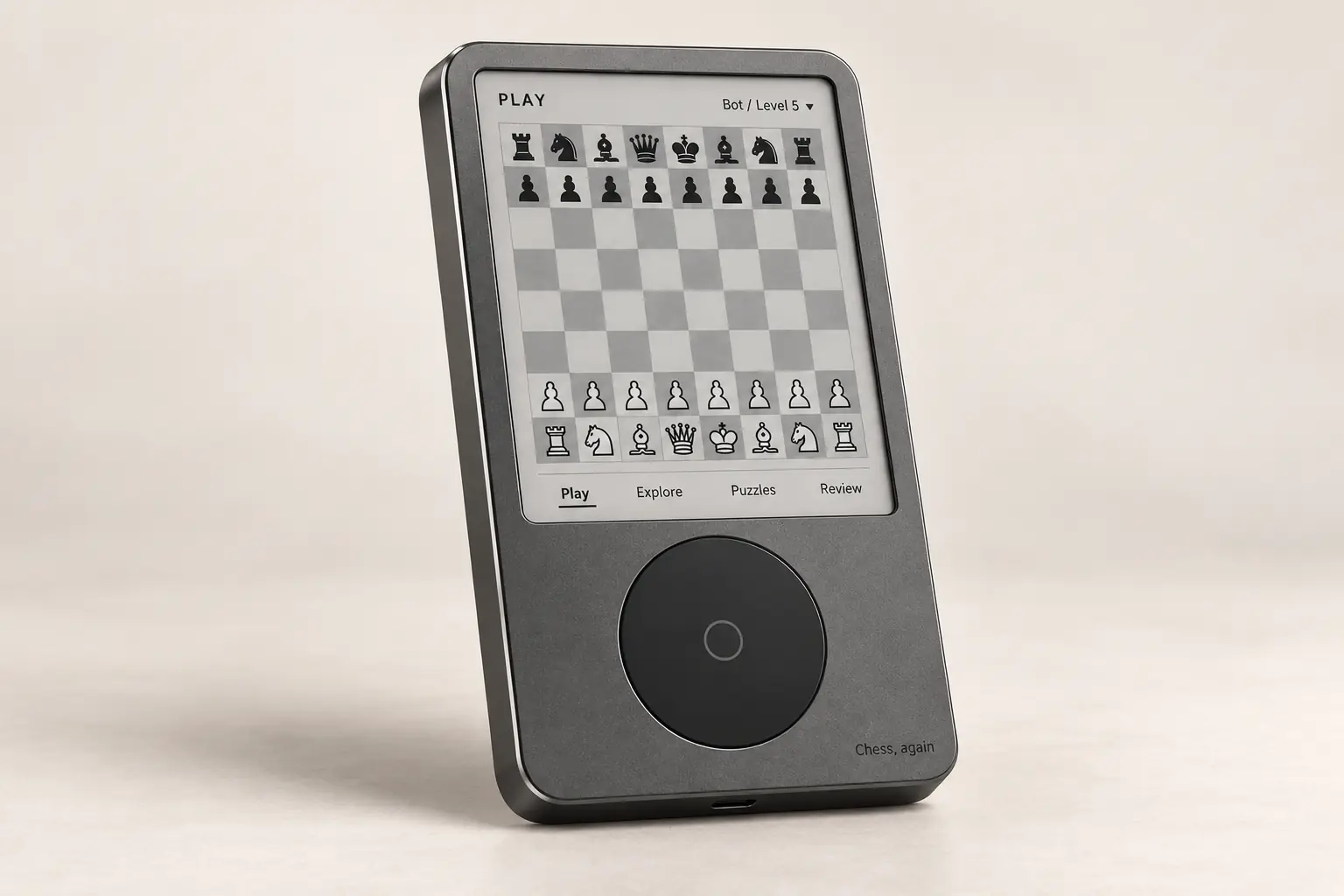
A satin charcoal colour study. The circular touch surface stays visually distinct and clear of the board.
Three touch joystick studies
What if the familiar circular control worked like a small trackpad? Your thumb could glide across the surface to move the highlight, then tap to select a piece or confirm a square. The board stays in view while your hand settles below it.
We are exploring three ways to give that idea a physical shape. Try each in the interaction study above; the sensing technology and final control design still need hardware testing.
A defined circular surface around a recognisable centre. Swipe across the ring to navigate and tap to choose. The shape could give your thumb a reference point without asking you to cover the board.
One continuous surface with a quiet centre marking. Navigate from anywhere on the disc, then tap to select. We want to explore how its texture and sensitivity could help movement feel comfortable and predictable.
A touch-sensitive area paired with a distinct centre. A physical confirmation button could give selection a deliberate finish. This is a design option to test, including whether touch and click work well together.
More than a match
Different days call for different kinds of chess. We are planning an experience that leaves room for a full game, a small puzzle and the question that keeps you thinking afterward.
An on-device opponent is planned for practice away from a connection. Choose a comfortable challenge and take a game along for the journey.
Explore the ideaA puzzle can turn a short break into time with the board. We are exploring tactical practice with help available when you want it.
Explore the ideaOptional move guidance is part of the learning direction. Explore legal moves, try an idea and get comfortable with the position.
Explore the ideaMove-by-move review is planned so you can return to a decision, follow the sequence and consider a different line.
Explore the idea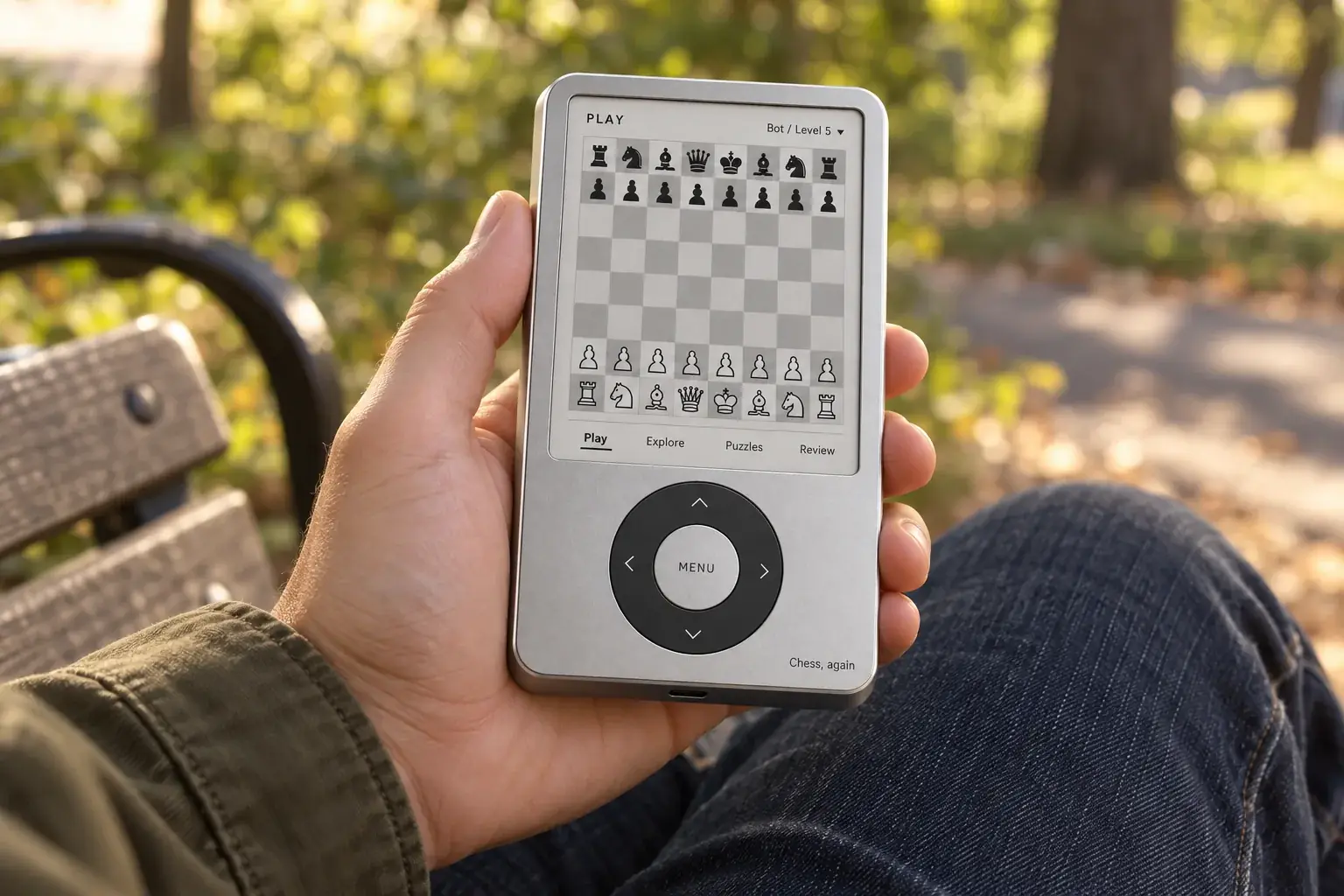
A more intentional break
A healthier relationship with play can be about the way you choose to spend your time. A dedicated device gives that choice a shape: pick it up for chess, spend a little time with the board, and put it down when the session is done.
No feed to fill the space between moves. No collection of unrelated apps. Our intention is a simple place to concentrate, with room for a short session to feel complete.
We are exploring a quiet monochrome display and comfortable controls. Screen technology and ergonomics remain in development; we are not promising medical benefits or measured reductions in eye strain.
Explore more intentional playSmall rituals, good company
You do not need a new routine for every part of life. Sometimes a familiar object is enough to remind you of something you already enjoy. Chess, again is an invitation to find those moments in the day you have.
While the kettle boils or the next meeting approaches, a single position can be a satisfying place to spend your attention. Our puzzle direction is about a clear beginning and a natural stopping point. A short session should have room to feel finished.
A dedicated object can belong to a favourite corner of your home. Reach for a practice game, think through an opening or challenge someone you know. We are exploring ways to resume and revisit a position, so the game can fit the evening rather than fill it.
Imagine a thoughtful gift for the friend who always suggests a match, or a shared game with someone learning the rules. Local play and approachable guidance are part of our direction. Gift options and what comes in the box will be confirmed when there is a product to order.
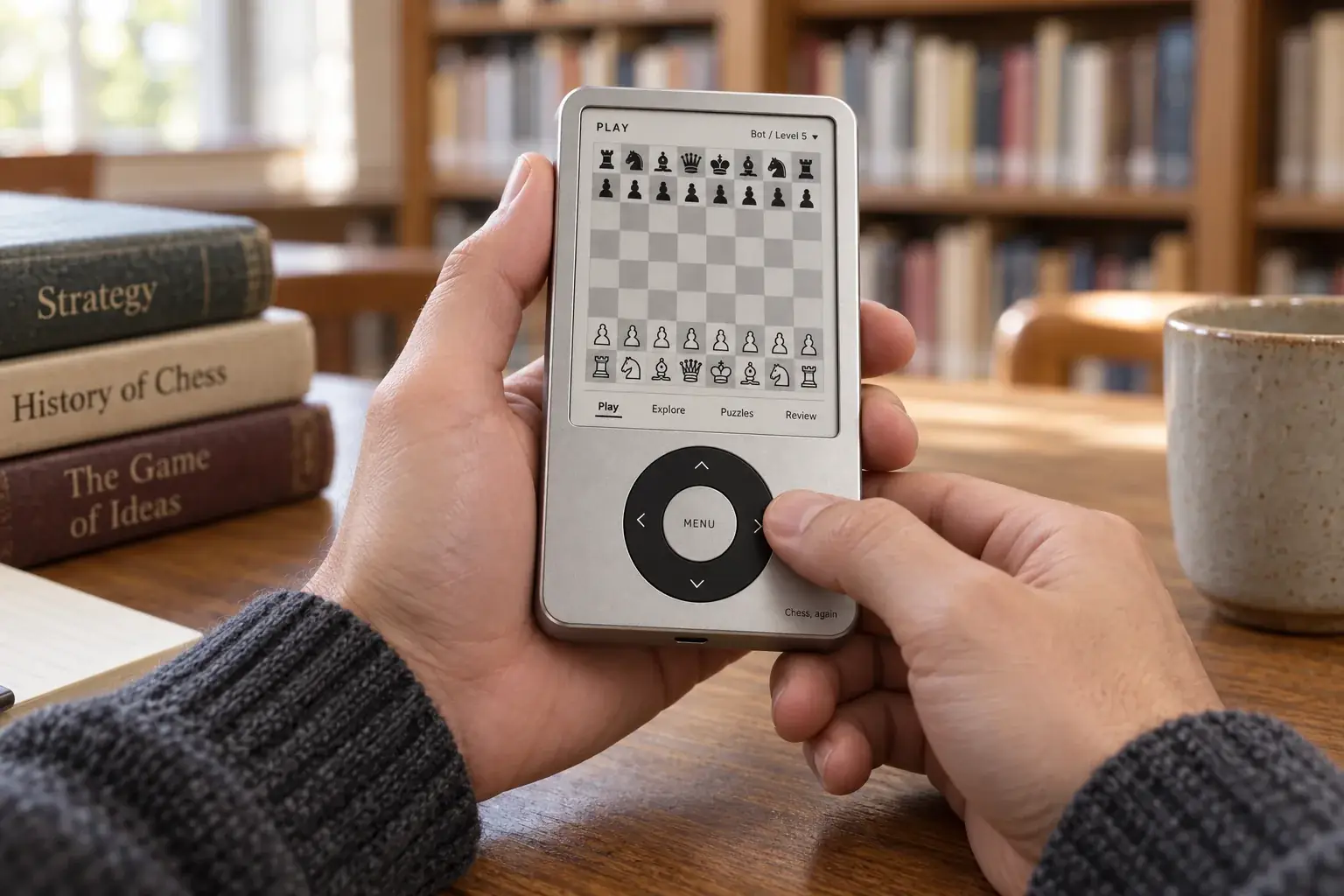
A board-first display direction
The pieces. The squares. Whose turn it is. We want the important parts of a game to be easy to find, with a quiet monochrome visual language that gives the board room.
Menus should help you get to the game and step aside. Optional guidance should appear when you ask for it. A selected piece should look selected, and confirming a move should feel like a separate, understandable action.
We are evaluating the display alongside the controls. Readability, response time, indoor and outdoor use, and how it feels over a longer session need real testing. The concept shows the look we want; it does not establish a display specification.
Read about the interface directionFind your kind of chess
A phone is convenient. A full-size board is a pleasure. Chess, again explores a place between the two.
| What matters to you | Your phone | A traditional board | Chess, again Concept |
|---|---|---|---|
| Where you play | On a device you already carry | At a table with room for pieces | A dedicated handheld |
| What shares the space | Chess alongside other apps | The board and pieces | An interface built around chess |
| How you move | Touchscreen | Move the pieces by hand | Physical controls; touch explored |
| Who you can play | Online and app-based opponents | Someone across the table | Online, local and computer play planned |
| Practice and review | Depends on the app you choose | Use your own study materials | Puzzles, guidance and review planned |
The device column describes the intended experience. Final capabilities and specifications are not yet confirmed.
Shared play · planned
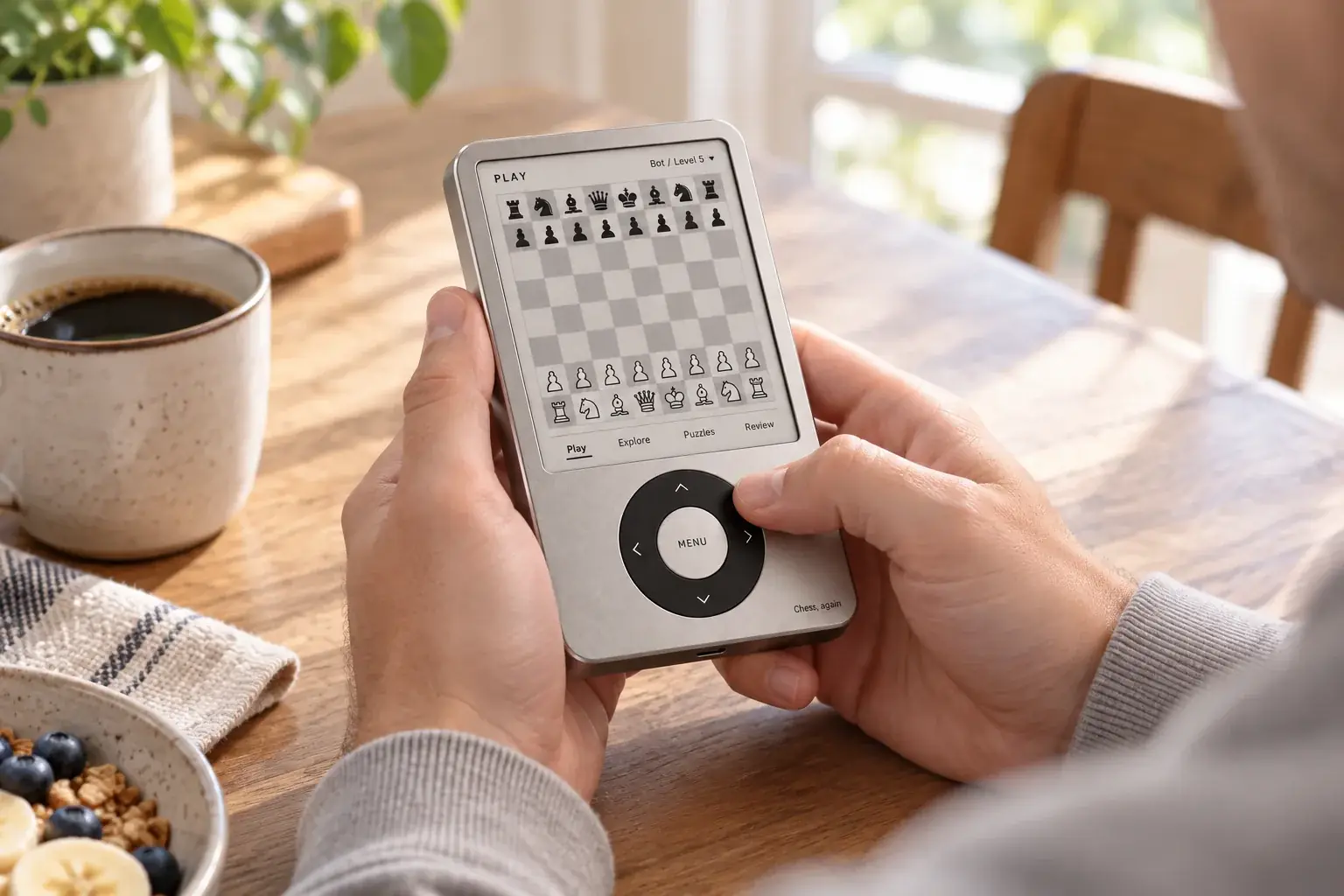
Some games are about a new opening. Some are an excuse to catch up. We are planning friend challenges through connected services and exploring local two-player play on a shared handheld.
A few moves over breakfast. A game with someone learning. A familiar opponent who always surprises you. The best part of chess can be the person across the board.
Explore playing togetherThe experience we are working toward
Online play, an offline opponent, a puzzle or a game together. We are shaping a clear starting point for each.
Navigate with physical controls, or explore our touch direction. Keep your attention on the board.
Finish a session, revisit a game or return when you have another moment. Resume and review features remain in development.
From the idea to your hands
The shape is a starting point. A useful product needs controls that feel right, software that is clear and a production plan that stands up to testing. Here is the path we want to follow, without attaching dates to work that still needs to happen.
The concept renders and browser studies help us ask better questions. Which input feels inviting? What would you reach for most? Feedback now can shape what we prototype next.
We need to evaluate control geometry, touch sensing, display response and comfort together. A browser can show a selection flow; only a physical prototype can tell us how it feels.
Offline play, puzzles and connected services need working software and clear boundaries. We will explain supported features, platform requirements and any recurring costs before purchase.
Confirmed specifications, box contents, pricing and delivery terms come before orders. We want you to decide with enough information, and we will share progress as the project develops.
A planned limited launch offer
Our price direction is $99 USD for a limited launch offer, with a planned regular price of $159 USD. We want the first release to be an approachable way to give chess a place of its own.
These are planned prices for a product in development. The launch allocation and offer terms are not set yet. Before orders open, we will confirm the hardware, what is included and the full cost, including taxes, delivery and any service charges.
Read about price and availability$99 USD
$159Planned regular price · USD
One dedicated place for your next move.
No payment today. The $159 comparison is a planned regular price, not a past selling price. Joining does not reserve a unit or guarantee the offer. Launch timing is unconfirmed.
Go a little deeper
Explore the thinking behind the device, the features we are planning and the questions we are still working through.
Why we are creating a dedicated handheld for chess: fewer competing apps, physical controls and a small ritual you can return to.
02Explore planned Chess.com and Lichess support for Chess, again, including connected games and a focused handheld experience.
03Explore physical controls and the touch interaction we are developing for the Chess, again handheld concept.
04Our plans for offline chess practice, adjustable computer opponents and a handheld that can travel with you.
05A focused place for chess puzzles, tactical practice and short sessions: the Chess, again product direction.
06Explore our plans for optional move guidance, approachable chess practice and learning through positions.
07Our direction for saved games, move-by-move review and exploring the decisions that shaped a chess game.
08Explore planned friend challenges and local two-player chess for the Chess, again handheld concept.
09A more intentional chess routine: fewer competing apps, clear stopping points and a dedicated space for the game.
10Explore the planned $99 USD limited launch price and $159 USD regular price for Chess, again. Free waiting list; no deposit or preorder.
11Explore three circular touch joystick concepts for Chess, again: a touch ring, a full touch disc and a hybrid centre with deliberate confirmation.
12Explore white and dark titanium colour concepts for Chess, again, and the materials we are considering for the enclosure and circular touch surface.
Where would you take yours?
The next move, before the next sip.
Be here for the first move
Join the waiting list for progress, early looks and a chance to help shape the device.
An early concept. Specifications, price and timing are still being explored.